You drop your bag, glance at the sink, and sigh—the counters are sticky, the floor’s gritty, and tomorrow’s already packed. Ten minutes become an hour. And somehow, the house still looks the same.
Cleaning without a plan steals time and peace. You bounce between rooms, redo tasks, forget others, and end up overwhelmed. You might even google ‘weekly cleaning schedule printable free’ at midnight and still wake to the same mess.
Here’s the thing: by the end, you’ll have a step-by-step system, ready-to-use templates, and a flexible rhythm that fits real life. You’ll download a weekly cleaning schedule printable free, customize it in minutes, and actually stick with it. Ready to make Week One feel easy?
Why A Simple Weekly Cleaning System Works
A simple weekly system works because it reduces decisions. Fewer choices mean less friction. When you know what to do today, you just start—no debate.
Wondering why that matters so much? Your brain pays a tax every time you switch tasks, called context switching. A light, repeatable schedule cuts that cost, spreads effort across the week, and keeps “deep clean” days from stealing your Saturday.
💡 Pro Tip: Anchor cleaning to fixed cues—after breakfast wipe counters, after dinner run the dishwasher, before bed reset living room. Anchors beat motivation every time.
According to the Centers for Disease Control and Prevention (CDC) household guidance, routine cleaning of high-touch surfaces reduces germ load and prevents buildup—translation: quicker upkeep, fewer marathons later.
| Approach | Time & Stress | Result Over 4 Weeks |
|---|---|---|
| No Plan (Random) | 60–90 min bursts, high stress | Inconsistent rooms; frequent rework |
| Simple Weekly System | 15–25 min daily, low stress | Even coverage; steady baseline clean |
| Weekend Binge Only | 2–4 hours at once, medium–high stress | Looks clean, then slides by midweek |
Picture this scenario: you’ve got 18 minutes before school pickup. With a system, you hit Tuesday’s block—bathroom wipe-down, mirror, quick floor sweep. Timer on, no thinking. You’re out the door calm, and the bathroom won’t ambush you Friday night.
- Habit stacking: Pair tasks with existing routines (coffee → counters).
- Batching: Group like tasks to save setup time (all mirrors, then all sinks).
- Time-blocking: Cap dailies at 20 minutes—enough to matter, short enough to repeat.
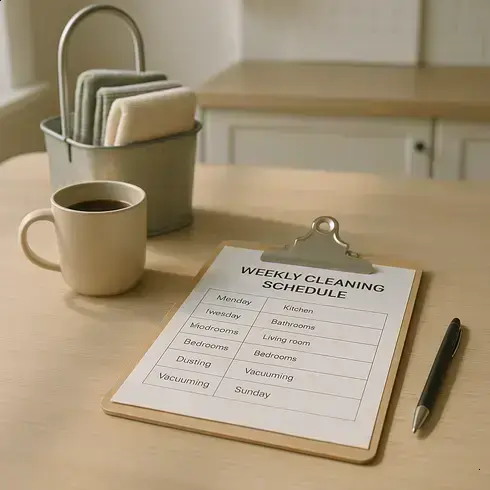
- Visible tracker: Post a weekly cleaning schedule printable where you see it.
- Capacity fit: Plan for your real week—travel days get lighter loads.
The truth is, 10–20 focused minutes a day often saves 1–2 hours on the weekend. And it keeps your space guest-ready without panic cleaning.
Dealing with mold, lead paint, or pest droppings? Consult a licensed professional for safety assessment and remediation before routine upkeep.
And this is exactly where most people make the most common mistake—packing the schedule with too many tasks on the wrong days…
What To Include: Rooms, Tasks, And Time Blocks
Wondering what actually belongs on a weekly plan? Think rooms, repeatable tasks, and realistic time blocks. When each slot is clear, you move—no second-guessing.
Here’s the thing: time blocks aren’t chores; they’re containers. You’ll cap effort, avoid scope creep, and still keep your space company-ready. Simple, tight windows beat vague “clean the kitchen” goals every time.
💡 Pro Tip: Use a consistent order in every room—top to bottom, dry to wet, back to front. Set a 15–25 minute timer and stop when it rings. Predictability builds momentum.
Suggested Time Blocks by Room
| Room | Core Tasks | Time Block |
|---|---|---|
| Kitchen | Counters, sink, stove top, spot mop | 20–25 min |
| Bathroom | Toilet, sink, mirror, quick shower wipe | 15–20 min |
| Living Room | Declutter, dust, vacuum or quick mop | 15–20 min |
| Bedrooms | Reset surfaces, change sheets (primary) | 15–25 min |
| Entry/Laundry | Shoes reset, wipe handles, one load | 15–20 min |
| Extras (rotating) | Baseboards, fridge clean-out, blinds | 10–15 min |
In practice: you’ve got 22 minutes before a Zoom call. You open your printable, see “Kitchen — 20–25.” You clear counters, degrease the stove top, run the dishwasher, and spot mop the traffic lane. Timer dings—you’re done, not drained.
- List rooms that matter weekly. Prioritize kitchens, bathrooms, and high-traffic zones before aesthetics-only spaces.
- Define 3–5 core tasks per room. Keep them small: wipe, dust, vacuum, reset. No deep-clean rabbit holes.
- Choose your daily window. Morning, after-dinner, or pre-bed—anchor blocks to an existing habit.
- Match time to soil level. Busy kitchens get 20–25; low-traffic rooms get 10–15.
- Assign rotation for extras. One small “extra” per day prevents buildup without weekend binges.
- Note tools per room. Microfiber cloths, HEPA vacuum, enzyme cleaner—stage them nearby to save minutes.
According to the American Lung Association, weekly vacuuming with a HEPA filter helps reduce allergens—pair that with damp dusting to trap particles. For disinfecting needs, the Environmental Protection Agency advises following labeled contact time to ensure efficacy, so schedule those minutes inside your block.
What actually works might surprise you…
Step-By-Step: Build Your Weekly Cleaning Schedule That Fits Your Life
Struggling to build a schedule that actually fits your week? Start simple. Map your life first, then slot cleaning into the gaps—never the other way around.
Here’s the thing: your energy changes by day. Mondays run hot, Thursdays drag, weekends flex. A good plan respects that reality and caps effort so you don’t burn out.
⚠️ Important Warning: Never mix bleach and ammonia, ventilate well, and follow product label directions. The American Cleaning Institute advises reading Safety Data Sheets and respecting contact times for disinfectants.
What You’ll Need
- One printed weekly cleaning schedule (or a dry-erase version)
- Pen or fine-tip marker; color-coding optional
- Digital timer or phone timer
- Microfiber cloths, all-purpose cleaner, disinfectant (EPA-registered)
- HEPA vacuum, small caddy per floor or zone
- Calendar app for reminders (Google Calendar, Apple Reminders)
Steps To Build Your Weekly Cleaning Schedule
- Audit your home zones. List kitchen, bathrooms, living areas, bedrooms, entry, and laundry. Note high-traffic spots and your top two pain points.
- Pick your daily window. Anchor to an existing habit—after dinner or before bed. Set a hard cap of 15–25 minutes on weekdays.
- Assign rooms to days. Example: Mon Kitchen, Tue Bathrooms, Wed Living, Thu Bedrooms, Fri Entry/Laundry. Keep weekends light.
- Define 3–5 core tasks per room. Write actions you can finish fast: wipe counters, toilet, mirrors, vacuum, reset surfaces. No deep-clean spirals.
- Add one rotating extra. Slot a small task each day (baseboards, fridge shelf, blinds) so deep cleans never pile up.
- Plan disinfecting with dwell time. Spray high-touch points, then clean something else while it sits—label contact times usually run 2–10 minutes.
- Stage tools by zone. Park a caddy where work happens. Fewer trips = more minutes saved.
- Test and tweak for capacity. Run the plan for a week, then shift tasks or time blocks based on real life.
In practice: picture this scenario—Tuesday’s bathroom block is 18 minutes between homework and dinner. You wipe the sink, swish the toilet, hit the mirror, then run a quick floor sweep. Timer dings, you stop, and the room still looks fresh.
According to the American Cleaning Institute, regular cleaning of high-touch surfaces reduces soil and germ buildup; pairing that with fixed time blocks supports consistent routines that actually stick.
And this is exactly where most people make the most common mistake—overloading one day and skipping buffer time when life gets messy…
Free Printable Options: Minimal, Family, And Apartment Versions
Choosing the right printable matters. Each version covers the same backbone—rooms, time blocks, and a tiny rotating extra—but the layout fits different lives.
Minimal is for you if cluttered planners make you stall. You’ll fill one daily block (15–25 minutes), list three core tasks, and add one rotating extra. Post it on the fridge and reset weekly.
Family works when more hands help. You’ll assign initials to tasks, check off dailies, and note shared zones. It keeps accountability visible—and arguments shorter—without micromanaging.
Apartment suits small spaces and tight schedules. You’ll bundle zones (kitchenette + living), plan quick resets, and schedule lightweight tasks like spot-mopping and dusting shelves. No weekend marathons needed.
In practice: your Sunday reset takes five minutes—you write time blocks, circle the rotating extras, and pencil initials for bathrooms and floors. By Thursday, you’re not guessing; you’re following a map.
💡 Pro Tip: Print on card stock, slip into a sheet protector, and use a fine dry-erase marker. Place it where you start your day—visibility drives follow-through.
Compare the Free Printable Versions
| Version | Best For | What It Includes |
|---|---|---|
| Minimal | Solo users, low visual noise | Daily time block, 3 core tasks, 1 rotating extra, quick notes |
| Family | Households with kids/roommates | Zones by day, initials box, shared dailies, consequence-free skip buffer |
| Apartment | Studios, 1–2 bedrooms | Combined zones, compact dailies, monthly deep-clean tracker, move-day checklist |
Here’s the thing: fill the times first, then the tasks. Update the page every Sunday night, keep it on a fridge clip or inside a clear acrylic frame, and stash a marker beside it.
According to the American Psychological Association, visible habit cues boost adherence, and simple checkboxes provide immediate reinforcement—exactly what a weekly cleaning schedule needs to stick.
What actually works might surprise you…
How To Stick With It: Habits, Reminders, And Quick Resets
Struggling to keep your schedule past week one? The truth is, sticking happens when habits carry the load—reminders and tiny resets just keep the wheels greased.
Think in cues, not willpower. Tie cleaning to moments you already do—after dinner, before bed, right after school drop-off—so your brain says “oh, this goes here” without a fight.
💡 Pro Tip: Put your caddy where the work starts, not in a hall closet. Lower friction wins—spray, wipe, done—before your motivation even weighs in.
Environment design matters. Keep a microfiber on the counter edge, stash a mini broom near the entry, and park a HEPA stick vac where crumbs happen. You’ll clean because it’s right there—not because you felt inspired.
Picture this scenario: you see the printable on the fridge and your 8:15 PM phone buzz—“Counters + Load Dishwasher.” You hit play on a 15-minute timer, clear surfaces, run the cycle, and do a 60-second sink shine. Timer dings; you’re finished, not frazzled.
Quick Resets That Save Your Week
| Reset | When To Use | Time Needed |
|---|---|---|
| 60-Second Sink Shine | After dishes to prevent film | 1 minute |
| Entryway Sweep & Reset | Before bed—shoes, mail, mats | 3 minutes |
| Crumb Trail Vacuum | Post-cooking in high-traffic lane | 5 minutes |
Here’s the thing: reminders should layer. Use one visual (the printable), one digital (calendar alert), and one physical cue (cloth by the sink). If one fails, another fires.
Make stickiness automatic with if–then plans—“If I start the coffee, then I wipe counters.” Research from University College London found habits become easier with repetition over time (often around 66 days on average), so aim for consistency, not perfection.
Worth noting: cap weekday blocks at 15–25 minutes and stop on the timer. That boundary prevents burnout and actually protects tomorrow’s follow-through.
Once this is in place, the rest of the routine falls into place naturally.
Your Weekly Cleaning Just Clicked
The big three: keep a simple weekly system with tight time blocks, list each room’s 3–5 core tasks, and post the right printable with reminders and quick resets. If you take just one thing from this guide, let it be: routine beats motivation—your weekly cleaning schedule printable free makes action automatic.
Before, chores piled up and weekends vanished. You bounced between rooms and second‑guessed every step. Now you’ve got a clear map. One page on the fridge. Fifteen to twenty minutes a day. Anchored habits, smarter sequencing, and fewer decisions. Cleaner space, steadier mood, more time back.
Which printable are you using first — Minimal, Family, or Apartment — and what 15–25 minute time block will you try tonight? Tell us in the comments!

About the Author:
Claire Anne Foster is a home organization enthusiast, lifestyle writer, and the founder of this blog — built for people who want a cleaner, calmer home without spending every weekend doing it.
After years of testing every organization system, planner, and cleaning routine she could find, Claire realized that most advice was either too complicated to maintain or too generic to be useful. So she started creating her own — simple, printable, and designed for real life with real schedules.
Claire is not a professional organizer or interior designer — just someone who genuinely loves a well-organized home and believes that the right checklist or routine can change how your entire week feels. Every resource on this site is practical, tested, and designed to be used — not just pinned and forgotten.
When she’s not writing or reorganizing her pantry for the third time, Claire is testing new meal planning systems, exploring better morning routines, and convincing her family that yes, everything does need a labeled bin.