You open a drawer for a charger, and five mystery cables tumble out. The counter’s buried under mail, mugs, and keys. This weekend can be different—quick, calm, done.
The clutter tax is real: lost time, late fees, and a low hum of stress that follows you from room to room. Decisions pile up, you stall, and the house never feels “done.” You’ve even searched declutter checklist printable free at midnight, then got stuck second-guessing every “just in case” item.
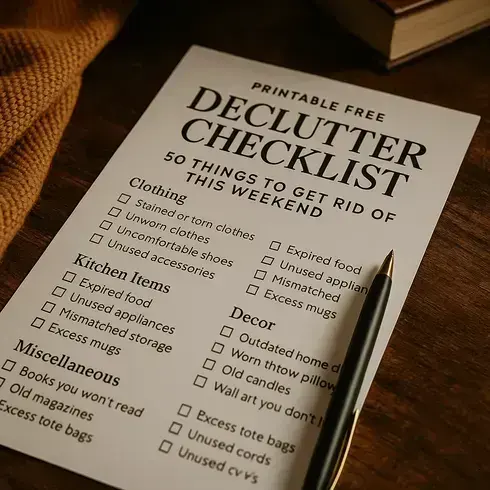
By Sunday night, you’ll have a one-page plan and a 50‑item hit list, room by room, plus fast rules for keep/donate/recycle/trash. You’ll also get a declutter checklist printable free you can print now and use in 15‑minute bursts. Ready? Let’s clear the first surface.
Quick Prep: Set A 60-Minute Game Plan
Worried an hour won’t cut it? Here’s the thing: a tight, timeboxed plan beats a vague weekend wish list—every single time. You’ll move faster, decide cleaner, and finish strong.
| Minute | Action | Why It Matters |
|---|---|---|
| 0–10 | Stage tools + print checklist | Removes friction, warms up decision muscles |
| 10–20 | Clear one surface fully | Instant win builds momentum |
| 20–40 | Run a 20‑item lightning round | Timeboxing prevents overthinking (decision fatigue) |
| 40–55 | Bag trash + box donations | Physical containment locks decisions |
| 55–60 | Reset room + quick sweep | Visual payoff keeps you coming back |
💡 Pro Tip: Set four 15‑minute timers and stop when they ring. The American Psychological Association notes that decision fatigue erodes judgment over time—short sprints protect willpower and raise follow‑through.
Gather only what speeds you up, not slows you down.
- Timer or phone stopwatch
- Three bins: Keep, Donate, Recycle (labeled)
- Trash bag (sturdy, 13–30 gal)
- Masking tape + marker for quick labels
- Printed declutter checklist (your declutter checklist printable free)
- Microfiber cloth for a fast reset
- Pick one zone with high traffic (entry table, kitchen counter). Commit: no hopping rooms.
- Start the first 15 minutes staging tools and printing the checklist. Tape it where you’ll see it.
- Do a “single‑touch” pass: each item handled once—decide Keep/Donate/Recycle/Trash in under 10 seconds.
- Run a 20‑item blitz using the checklist. Count out loud; the number keeps pace honest.
- Contain decisions: bag trash, close the donation box, and label it with today’s date.
- Reset: wipe the surface, return true keeps to a defined “home,” and take out trash now—don’t leave it parked.
Picture this scenario: you hit the kitchen counter at 5:30 p.m., kids’ art, expired coupons, five coffee lids. By 5:55, two bags leave the house, the counter gleams, and your brain—finally—quietens. That’s momentum.
Worth noting: research from Princeton Neuroscience Institute shows visual clutter competes for attention, lowering focus. Your 60‑minute plan reduces noise first, then locks wins with containers and a visible finish line.
Ready to pick the next zone? What actually works might surprise you…
Room-By-Room: 50 Items To Toss, Donate, Or Recycle
You’ll move faster when decisions are local to each room. Think exits first—Trash, Donate, Recycle—then sweep the obvious stuff that stalls your day.
| Room | Fast Wins | Best Exit |
|---|---|---|
| Kitchen | Expired spices, warped lids | Trash/Recycle |
| Bathroom | Old makeup, empty bottles | Trash/Recycle |
| Closet | Stretched tees, duplicates | Donate |
In practice: picture this scenario—ten minutes per room, one bin per exit. You’ll see space open up and your brain relax with every bag sealed.
💡 Pro Tip: Keep a small “maybe” bag per room and revisit it in 24 hours. According to the U.S. Environmental Protection Agency, separating household hazardous waste (like batteries and e‑waste) prevents contamination and cuts landfill risk.
Kitchen (10)
- Expired spices
- Cracked mugs
- Warped lids
- Stained containers
- Chipped plates
- Dead gadgets
- Takeout packets
- Old water bottles
- Crusty bake sheets
- Single‑use tools
Bathroom (10)
- Expired meds
- Old makeup
- Dried nail polish
- Frayed towels
- Empty bottles
- Duplicate razors
- Cracked hair ties
- Stale sunscreen
- Expired floss picks
- Broken brushes
Bedroom (10)
- Mismatched socks
- Worn sheets
- Broken hangers
- Dead batteries
- Extra pillows
- Extra chargers
- Old candles
- Stretched leggings
- Obsolete alarm clock
- Tangled jewelry
Living Room (10)
- Scratched DVDs
- Dusty decor
- Broken remotes
- Games missing pieces
- Frayed throws
- Old magazines
- Extra vases
- Dead plants
- Old coasters
- Unused frames
Home Office (10)
- Dried pens
- Mystery cables
- Outdated manuals
- Expired warranties
- Junk mail
- Duplicate notebooks
- Bent paper clips
- Old business cards
- Cracked phone cases
- Empty cartridges
Worth noting: the Food and Drug Administration outlines safe medication disposal, and most cities host e‑waste drop‑offs for cartridges and batteries—check your local program.
And this is exactly where most people make the most common mistake…
Keep, Donate, Recycle, Trash: How To Decide Fast
Stuck on “what if I need it later?” Here’s the thing: speed comes from rules, not willpower. Use clear triggers and you’ll decide in seconds.
| Item Cue | Decision Trigger | Exit |
|---|---|---|
| Duplicate tools | Two or more of same use | Donate |
| Worn or damaged | Rips, chips, won’t function | Trash/Recycle |
| One‑year idle | Not used in 12 months | Donate |
| E‑waste/batteries | Can’t be used safely | Recycle (certified) |
| Sentimental paper | Photo taken; info saved | Trash/Shred |
💡 Pro Tip: Decide by replacement ease: if you can replace it for under $20 in under 20 minutes, let it go. The U.S. Environmental Protection Agency highlights “reduce and reuse” above recycling—fewer keepers save more space. For tax-deduction questions on donations, consult a qualified tax professional.
90‑Second Decision Drill
- Hold the item and ask: Did I use this in the last year? If no, it’s likely not a keeper.
- Check condition and safety. Cracked plastics, frayed cords, expired goods—these are nonnegotiable exits.
- Estimate replacement cost/time. Easy and cheap to replace? Favor Donate or Recycle.
- Assign an exit bin now: Keep, Donate, Recycle, Trash. One touch only.
- Label the donation box with today’s date for pickup or drop‑off planning.
- For bulk or oversized items, schedule curbside pickup or a junk removal service before momentum fades.
Picture this scenario: you’re holding a third spatula, a hoodie with peeling print, and a tangle of HDMI cables. In 90 seconds, you donate two, recycle the cables at an e‑waste event, and keep one spatula—the drawer finally closes.
Edge cases? Use simple safeguards.
- Heirlooms: keep a curated “memory box” with a one‑bin limit.
- High resale value: if it’s worth $25+ and lists in 5 minutes, sell; otherwise donate.
- Hazardous waste: paint, chemicals, sharps—follow your city’s HHW rules per local sanitation or SWANA guidance.
Worth noting: Goodwill Industries posts clear donation guidelines, and certified e‑waste recyclers handle data‑bearing devices safely (factory reset first). This reduces storage costs and avoids hidden landfill fees.
But there’s one detail most owners completely overlook until it’s too late…
Printables: One-Page Checklist You Can Use Today
A one-page checklist removes guesswork and stalls. Instead of fifty tiny decisions, you’ll follow a clear map—fast, visible, repeatable. That’s how you win weekends back.
Here’s the thing: the page works like a control panel. Top bar shows four exits (Keep, Donate, Recycle, Trash). Center grid lists 50 common items room‑by‑room with tiny checkboxes. Right margin tracks timers, bag counts, and a quick donation log for receipts.
How To Use It In 15 Minutes
- Print one copy in grayscale and clip it to a clipboard. If you’ve got a sheet protector, slide it in and use a dry‑erase marker.
- Tape the page where work happens—fridge, entry table, or the first clutter zone. Visual cues stop wandering.
- Start a 15‑minute timer. Work only one surface. Check off 5–10 items from the grid; ignore everything else.
- Mark exits as you go. Tallied one donation bag? Note it in the margin with date, location, and a simple item count.
- Pause at the timer. Bag trash, close the donation box, and write “OUT” when it reaches the door or car.
- Snap a photo of the filled page. File it in a “Home Reset” album for progress tracking and donation records.
💡 Pro Tip: Keep a laminated copy on a clipboard with a fine dry‑erase marker. According to the National Association of Productivity & Organizing Professionals, visible prompts near the point of action increase follow‑through and reduce task switching.
In practice: Jamie prints two copies—one for the kitchen, one for the entry. After two 15‑minute sprints, three bags leave the house, receipts are noted, and the counter finally breathes. No drama, just flow.
Customization is simple. Busy families can color‑code exits or pre‑highlight the top 10 items. If you use curbside pickup or a junk removal service, add the pickup day to the margin so bags actually leave. Store the clipboard where clutter starts, not where it “should” live—fridge side, mudroom hook, or the office door.
Worth noting: a clear checklist tightens decision rules, cuts choice overload, and supports a repeatable routine. But there’s one detail most owners completely overlook until it’s too late…
Aftercare: Smart Habits To Keep Clutter From Creeping Back
Here’s the thing: clutter creeps back when “aftercare” is fuzzy. You don’t need more bins—you need tiny, automatic moves that erase friction before it piles up.
| Moment | 60‑Second Habit | Trigger |
|---|---|---|
| Mail arrives | Stand, sort, recycle ads; file one bill | Keys hit the entry table |
| Laundry day | One‑in, one‑out for tees or socks | Folding the first stack |
| Trash night | Empty small bins; bag donation for car | Rolling the bin to curb |
| Work shutdown | Two‑minute surface sweep | Closing the laptop |
| Saturday coffee | Drop a donation bag | Grabbing car keys |
💡 Pro Tip: Build “departure points”—a fixed spot by the door with a labeled donation bag. When you leave for errands, the bag leaves too. Fewer steps, less friction, better follow‑through.
In practice: Alex tapes a small sign near the garage door—“Out = Donate.” By week two, every Saturday coffee run includes a trunk drop. Counters stay clear, and the family stops debating where things go—they just follow the cues.
The truth is: habits stick when they’re anchored to existing routines—this is habit stacking. Research from University College London found new habits take an average of 66 days to become automatic, with wide variation. And UCLA’s Center on Everyday Lives of Families observed that visual clutter raises stress signals in busy households.
Focus on containment, not more storage. Set a capacity cap: once the toy bin or snack basket is full, something exits before anything enters. That kills “just‑in‑case” buying, reduces self‑storage fees, and keeps replacement cost thinking honest.
Worth noting: a weekly five‑minute “inventory audit” (donation tally, recycling check, worn‑out list) prevents backsliding. You’ll spot operational friction early—bulging paper piles, mystery cables—before they metastasize into weekend‑stealing messes.
Picture this scenario: Sunday night, you do a two‑minute sweep, toss expired coupons, and move a ready bag to the trunk. Monday morning starts quiet—no hunting, no second‑guessing, no sprinting through clutter to find keys.
Small steps, repeated consistently, make the biggest difference over time.
Your Weekend Declutter Is Doable
You’ve got what actually works: a 60‑minute game plan, a room‑by‑room list of 50 easy wins, and fast keep/donate/recycle/trash rules. Plus a one‑page printable to guide momentum, and tiny aftercare habits that keep spaces clear. If you take just one thing from this guide, let it be: routine beats perfection—short sprints, clear exits, visible progress. Your declutter checklist printable free makes starting simple.
Before, every drawer felt noisy and slow. Decisions dragged, piles grew, and weekends vanished under good intentions. Now you’ve got a timer, a map, and exits that lock choices in place. One zone at a time. Bags out the door. Surfaces calm. It won’t be fancy, but it will be finished—and that’s the win you’ll feel tomorrow morning.
Which zone will you tackle first—entry table, kitchen counter, or that “everything” drawer? Tell us in the comments!

About the Author:
Claire Anne Foster is a home organization enthusiast, lifestyle writer, and the founder of this blog — built for people who want a cleaner, calmer home without spending every weekend doing it.
After years of testing every organization system, planner, and cleaning routine she could find, Claire realized that most advice was either too complicated to maintain or too generic to be useful. So she started creating her own — simple, printable, and designed for real life with real schedules.
Claire is not a professional organizer or interior designer — just someone who genuinely loves a well-organized home and believes that the right checklist or routine can change how your entire week feels. Every resource on this site is practical, tested, and designed to be used — not just pinned and forgotten.
When she’s not writing or reorganizing her pantry for the third time, Claire is testing new meal planning systems, exploring better morning routines, and convincing her family that yes, everything does need a labeled bin.