Alarm goes off. You hit snooze—twice. Coffee in hand, you rush through emails and out the door, already behind. It isn’t you; it’s the missing plan.
When mornings lack structure, your brain burns energy on tiny choices. Decision fatigue sets in, delays stack up, and stress follows you all day. The quiet price is focus, time, and confidence.
By the end, you’ll shape a simple, step‑by‑step morning and lock it in with cues, habit stacks, and a clean daily routine planner printable free. You’ll know what to do, when, and why—no guesswork. Let’s kick off with clarity.
Identify Your True Morning Priorities
What actually deserves your best morning energy—email, workouts, or that quiet deep‑work block you keep postponing? Here’s the thing: mornings set the tone for everything that follows.
True priorities are outcomes, not activities. They tie directly to a weekly goal, move a key metric, and fit your natural energy curve — not your calendar’s noise.
According to the American Psychological Association, decision fatigue builds as the day goes on, reducing self‑control and accuracy. So front‑loading high‑impact work early protects quality and focus when they’re strongest.
| Priority Type | Example Outcome | Best Energy Window |
|---|---|---|
| Non‑Negotiable Outcome | Submit proposal draft hitting KPI milestones | First 60–90 minutes after wake |
| Growth Task | Skill practice or strategic planning page | Late morning when alertness stabilizes |
| Maintenance Task | Inbox triage or scheduling | Afternoon dip — low cognitive load |
💡 Pro Tip: Write 1–3 MITs (Most Important Tasks) for the morning and anchor the first to a cue — coffee finished = open planner, headphones on, timer set for 25 minutes.
Tools you’ll need:
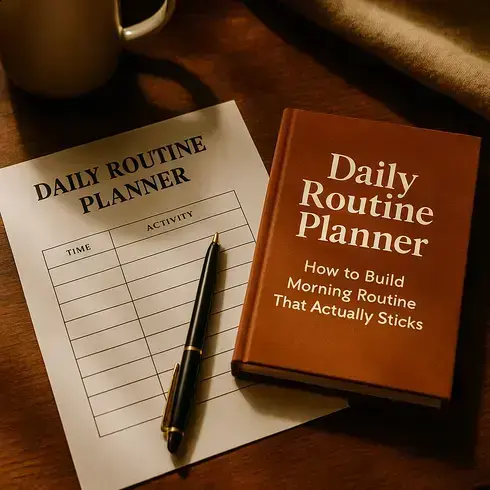
- Printed daily routine planner (time blocks + MIT area)
- Pen or highlighter
- Simple timer or phone in focus mode
Time required: 5 minutes. Prerequisite: One clear weekly outcome or KPI you’re driving.
- Scan your week goal and name the single “needle mover.”
- Brain‑dump tasks for today without editing.
- Score each task: Impact (H/M/L) and Effort (H/M/L).
- Match top High‑Impact, Medium‑Effort tasks to your circadian peak window.
- Select 1–3 MITs for the morning; park the rest in later blocks.
Picture this scenario: Alex, a manager and parent, stopped opening email first. He picked one non‑negotiable — finish a project brief — and blocked 45 minutes right after breakfast.
By week’s end, he shipped two briefs, did a 10‑minute mobility routine, and handled inbox after lunch. Not perfect — but consistent and calm.
Worth noting: prioritize outcomes that change a metric (revenue, applications, pages drafted) over motions that only feel productive. Your morning should buy leverage, not just activity.
What actually works might surprise you — the next step is designing a realistic 60–90 minute block that locks these choices into place…
Design A Realistic 60–90 Minute Routine Block
What fits inside 60–90 minutes — and still feels human? A realistic block respects your energy, removes friction, and stacks wins without burning you out.
Here’s the thing: your chronotype (natural sleep–wake rhythm) affects focus and stamina. The National Sleep Foundation notes consistent wake times and morning light improve alertness — perfect for deep work early.
Keep it simple, then protect it with guardrails. Small constraints beat vague ambition every time.
- Printed daily planner with 60–90 min blocks
- Pen/highlighter and a simple timer
- Headphones with a no‑lyrics playlist
- Water bottle; optional yoga mat
- Phone set to Focus/Do Not Disturb
- Pick a fixed start + cue: Example: 7:00 AM right after coffee. Make it recurring on your calendar. Aim for a 75‑minute default inside a 60–90 range.
- Map the structure: Prime (5 min: hydrate + bright light), Activate (10 min: mobility or brisk walk), Focus (45–60 min: one SMART outcome), Buffer (5–10 min: tidy handoff).
- Set guardrails: Focus mode on, one‑tab rule, notifications off, headphones on. Reduce switching costs — every context jump taxes working memory.
- Preload the night before: Open the doc, stage tools, lay out clothes. Use an implementation intention: “At 7:10, I’ll draft 300 words in [document].”
- Add a transition ritual: Last 5 minutes, log progress, pick tomorrow’s MIT, and leave a single sticky cue for Next Action.
- Track and score: On paper, mark completion, mood (1–5), and minutes. Optional: note HRV or sleep quality from a wearable for patterns.
- Create a lite version: If you’re 15+ minutes behind, run 3‑min prime, 25‑min focus, 2‑min buffer. Done > perfect.
💡 Pro Tip: Set a “hard‑stop” alarm at minute 70. Stopping while you still have momentum fights Parkinson’s Law and leaves room to close loops cleanly.
Picture this scenario: Maya, a product lead and parent, locked a 7:00–8:15 AM block. She primed with water and light, walked five minutes, then built her roadmap for 50 minutes. By 8:10, she logged wins and set one Next Action — and shipped the deck by Friday.
If you have medical conditions or training constraints, talk to a healthcare professional before changing sleep, nutrition, or exercise routines.
And this is exactly where most people make the most common mistake — they forget to right‑size the block for real life…
Use Habit Stacking And Triggers To Lock It In
Your habits don’t fail because you’re lazy — they fail because they’re floating. Triggers give them gravity. Habit stacking snaps the new action onto something you already do every morning.
Here’s the thing: an implementation intention — the classic “If X, then I’ll do Y” plan — doubles down on follow‑through. Research by NYU psychologist Peter Gollwitzer shows if‑then planning reduces hesitation and decision fatigue when it’s time to act.
| Trigger Type | If–Then Example | Reliability Tip |
|---|---|---|
| Object Cue | If I set my mug down, then I’ll open my planner. | Place objects in the exact spot you’ll see them. |
| Time Cue | If it’s 7:10 AM, then I’ll start my 25‑min focus timer. | Use one alarm — same tone, same minute daily. |
| Location Cue | If I sit at my desk, then I’ll put on headphones. | Keep the desk clear; reduce competing cues. |
💡 Pro Tip: Pair one high‑friction habit (deep work) with a low‑friction trigger (coffee ritual). The pleasure of the cue piggybacks motivation into the first 90 seconds.
Build Your Stack In Minutes
- Pick the anchor: Choose a guaranteed morning event — coffee, teeth brushing, unlocking your laptop.
- Write the if‑then: “If I finish coffee, then I’ll draft 150 words.” Keep it concrete and observable.
- Stage the cue: Put the planner and pen next to the mug; headphones on the keyboard; timer at zero.
- Start tiny: First week = two‑minute minimum. Winning small flips the reward prediction loop in your favor.
- Run a single loop: Trigger → one action → short reward (check mark, stretch, sunlight). No multitasking.
- Audit weekly: Note misses, then tweak the trigger, not your willpower.
In practice: Jordan stacks focus time on coffee. Mug down, planner open, 25‑minute timer on. Ten of fourteen mornings clicked in week one — because the cue did the heavy lifting.
Common pitfalls and quick fixes:
- Trigger too vague? Tie it to a physical action, not a mood.
- Environment noisy? Add headphones as a pre‑action micro‑cue.
- Reward missing? Use a visible check mark and two deep breaths by a window.
According to the American Psychological Association, consistent cues reduce cognitive load, making the routine feel automatic faster. What actually works might surprise you — the next move is tracking those wins on paper so the habit compound effect is impossible to ignore…
Track Progress With A Free Printable Planner Template
How do you know your routine is working — not just happening? Tracking turns good mornings into repeatable systems, because what you measure starts to improve.
Here’s the thing: a free printable planner template removes guesswork. University College London research on habit formation shows consistency grows when feedback is visible and timely, which is exactly what paper does well.
| Template Section | What To Fill | Why It Matters |
|---|---|---|
| MIT Box | 1–3 Most Important Tasks | Focuses effort on outcomes, not noise |
| Time Blocks | Start–end for 60–90 min | Protects deep work from drift |
| Habit Stack | If–then trigger line | Reduces hesitation at start |
| Mood/Energy | 1–5 quick rating | Spots sleep and stress patterns |
| Win/Learn | One sentence reflection | Builds improvement loop daily |
💡 Pro Tip: Keep the planner within arm’s reach of your cue — next to your mug or keyboard — so checking the box becomes part of the ritual.
How To Use The Printable
- One printed daily page (or two, double‑sided)
- Pen/highlighter and a small clip or clipboard
- Timer on your phone or desk
- Optional: color code for projects
- Print tonight: Stage tomorrow’s page where you’ll see it first.
- Set goals: Write 1–3 MITs tied to a weekly outcome or KPI.
- Block time: Reserve a 60–90 minute window and add your if–then trigger.
- Run the block: Start the timer; check boxes only when truly done.
- Score it: Mark completion %, mood 1–5, and a one‑line Win/Learn.
- Midday pulse: Re‑rate energy; shift one task if needed.
- Weekly review: Tally win rate and streak; choose one tweak for next week.
In practice: Nora, a remote designer, tracked two weeks on paper. Her win rate rose from 46% to 71% after adding a single change — moving email to after lunch.
Worth noting: paper beats apps for morning focus because it’s friction‑light and distraction‑free. Pair it with habit cues, and your “done” boxes start to tell a clear story.
And this is exactly where most people make the most common mistake — they don’t troubleshoot dips or plateaus with simple adjustments…
Troubleshoot, Adjust, And Stay Consistent For 30 Days
Struggling to stay consistent for 30 days — even after a strong first week? Here’s the thing: you don’t need perfect days. You need a dependable “floor” version and tiny course corrections.
Start with a baseline week. Run the same block daily, then set a floor–ceiling range: floor = 25 minutes, ceiling = 90 minutes. Hit an 80% adherence target, not 100%; perfection invites all‑or‑nothing thinking and burnout.
The truth is: momentum grows when effort feels winnable. Research from the Stanford Behavior Design Lab shows tiny behaviors plus immediate celebration help lock identity (“I’m a morning person who ships work”). And the American Academy of Sleep Medicine notes that a fixed wake time with morning light strengthens circadian cues — a quiet but powerful consistency lever.
💡 Pro Tip: Use a one‑line scorecard right on your planner: Adherence %, Energy 1–5, Output (what shipped). Do a Sunday pre‑mortem — list three likely blockers (travel, meetings, kid drop‑off) and time‑box Plan B slots before the week begins.
Picture this scenario: Taylor, a remote marketer with school drop‑off duties, ran 30 days. Week 1 proved the baseline (four of five mornings, 45 minutes). Week 2 slid due to inbox creep; she moved email to after lunch and rebounded to 80% adherence. Week 3 dipped from sleep debt; she added a 10:30 PM lights‑out and morning light by the window. Week 4 brought travel — she used a two‑minute floor routine and still shipped a short brief.
When should you tweak — and how much? If focus drops, tighten the block to 30–45 minutes and trim scope, not standards. If energy lags, move hydration and a three‑minute mobility set to minute zero. If interruptions spike, enforce a one‑tab rule and add headphones as a start cue. If motivation fades, rewrite your reason in outcome terms (finish the proposal that moves revenue), then text an accountability partner a single morning win.
Worth noting: measure inputs and outputs together. Time‑blocked minutes tell you consistency; shipped drafts, pages, or slides tell you impact. Combine both, and you’ll see which levers raise productivity without increasing context switching or stress.
Small steps, repeated consistently, make the biggest difference over time. Once this is in place, the rest of the routine falls into place naturally.
Your Morning Routine, Locked In
You’ve nailed the three levers: clear morning priorities tied to outcomes, a realistic 60–90 minute block with guardrails, and habit stacking plus on‑paper tracking. The daily routine planner printable free keeps feedback visible, so wins repeat. If you take just one thing from this guide, let it be: protect one focused morning block, anchored to a trigger and measured on paper — consistency beats intensity.
Before, mornings felt reactive — email first, focus last, energy leaking by noon. Now you’ve got a simple map. Cue, prime, focus, buffer. Small steps, scored daily, build momentum you can feel. Less noise. More shipped work. Calmer starts.
Which piece are you trying first — identifying your top outcome, locking a 75‑minute block, or printing the tracker for tomorrow morning? Tell us in the comments!

About the Author:
Claire Anne Foster is a home organization enthusiast, lifestyle writer, and the founder of this blog — built for people who want a cleaner, calmer home without spending every weekend doing it.
After years of testing every organization system, planner, and cleaning routine she could find, Claire realized that most advice was either too complicated to maintain or too generic to be useful. So she started creating her own — simple, printable, and designed for real life with real schedules.
Claire is not a professional organizer or interior designer — just someone who genuinely loves a well-organized home and believes that the right checklist or routine can change how your entire week feels. Every resource on this site is practical, tested, and designed to be used — not just pinned and forgotten.
When she’s not writing or reorganizing her pantry for the third time, Claire is testing new meal planning systems, exploring better morning routines, and convincing her family that yes, everything does need a labeled bin.